
Travelling is the art of freedom and fear. Whenever we get into the road or onto an aircraft, we always have a silent question of whether we are safe. The grumbling roadsides are not strange to most people, and the huge, open sky brings about both fear and fear. However, when it comes to raw statistics and professional safety level, is it safer to fly or to drive? This paper will bring you on a trip of numbers, legends, and facts to provide a definitive answer to the query, “Is flying safer than driving?”
Understanding Travel Safety: Flying vs Driving
It is worth understanding what exactly is meant by such term as travel safety before we start discussing numbers and protocols. Safety is not merely a statistical concept; it is a matter of control, training, regulation, and predictability. In answering the question, Is flying safer than driving, we have to take into consideration the objective information as well as the human perceptions about travelling.
The Global Safety Standards
Fear is nothing compared to the numbers. According to the World Health Organization, road accidents kill more than 1.3 million people annually across the globe, whereas the number of accidents in commercial aviation is extremely small, and the annual world fatality rate is approximately 50.
Deaths per billion miles:
- Driving: 7.3 deaths
- Flying: 0.07 deaths
This astounding difference indicates that statistically, air transportation is exponentially safer as compared to road transportation. Even a careful driver will not be able to compete with trained pilots and controlled airspace.
Risk Perception vs Reality
People are very curious beings: our brains tend to deceive us. Its people also have more fear of flying, compared to driving, despite the fact that it is safer to fly. This stems from:
- Loss of control: Drivers think they are in control of a car, although it may not be true.
- Media impact: When a plane crashes, it is a headline; when there is a car accident, it is an unnoticed event.
- Phobia of height and closed areas: Results in panic attacks, even though it is safe.
The knowledge of these psychological aspects can enable us to be able to reconcile our instincts with facts.
Key Factors Making Flying Safer Than Driving: Is Flying Safer Than Driving
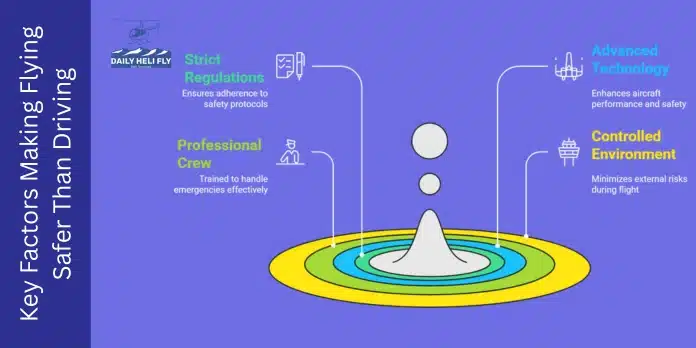
Flying is not just a means of transport- it is a well-planned orchestra of technology, training, and control. In this section, one will find out why flying is safe is not a catchphrase, it is a fact based on strict procedures.
The safety of flying is better than driving because of various important aspects:
Strict Regulations and Safety Standards
Air travel is subject to intensive observation:
- The airline companies have to follow the international civil aviation regulations.
- Countless hours of training are conducted on pilots before they can command a plane.
- Routine maintenance and auditing are obligatory.
The framework will ensure all flights are of the best safety standards.
Advanced Technology in Modern Aircraft
Planes are wonderful works of engineering:
- Human error is reduced by means of autopilot and navigation systems.
- A collision avoidance system is used to alert pilots about the aircraft or obstacles around them.
- Pilots avoid turbulence and storms with the help of weather radar.
Air travel is more predictable and safe, and driving does not have this kind of technology for individual drivers.
Professional Crew And Emergency Protocols
Each of the crew members is trained to manage the crisis: pilots, flight attendants, and so on.
- The cabin crews train on emergency measures.
- All the critical functions are backed up in pilots.
- Radio contact with the air traffic control is guaranteed of immediate assistance.
On the contrary, the drivers are usually left to use only intuition when an emergency arises.
Controlled Environment vs Unpredictable Roads.
Highways are volatile and fluctuating:
- Risks are increased by pedestrians, bicycles, and other cars.
- Weather, road conditions as well as traffic laws are diverse.
- Each mile brings in possible dangers.
Air travel, on the other hand, happens within a well-monitored and controlled environment, minimizing any unforeseen threats.
Common Misconceptions About Flying Safely
In spite of all these facts, there are still myths about aviation. Knowledge of such myths will be a key to making the argument that flying is safer than driving.
“Planes Crash More Than Cars” Myth
This is statistically false. Plane crashes are infrequent, although dramatic. Auto crashes occur on a regular basis, and are much deadlier on a per-mile basis.
Media Influence on Fear of Flying
Fear is enhanced by news coverage:
- Plane crashes take over the news.
- Car accidents are not much noticed despite the increase in frequency.
- The fear disproportions to the reality.
Turbulence Doesn’t Equal Danger
In a turbulent air, it is uncomfortable, but seldom hazardous:
- Planes are created to cope with severe turbulence.
- Pilots are trained to be able to avoid being involved in a turbulent environment.
- Accidents associated with turbulence are low.
The knowledge of these facts supports the idea of why air travel is a safe option for people who are afraid of accidents.
Real-Life Statistics Comparing Flying and Driving.
Where perception is deficient, numbers are clear. We can compare the process of flying and driving based on real-world data that is credible.
Fatality Rates Per Passenger Mile
- Driving: 7.3deaths/billion miles.
- Commercial Flying: 0.07 deaths per billion miles.
This means that one is more than 100 times safer when on the air than on the road.
Accident Likelihood and Severity
Car accidents are much more common:
- Minor accidents occur every day, all over the globe.
- The death of cars is common as opposed to the death of planes.
- Plane accidents are devastating, but they are not frequent because of the redundancy of safety.
Case Studies and Historical Examples
- Technology has reduced accidents in commercial aviation by a huge margin over the last several decades.
- Poor infrastructure and human behavior are constraints in the improvement of road safety.
These illustrations point to the truth: flying is safer than driving, even for frequent travelers.
Tips to Make Any Travel Safer

In spite of statistics that favor flying, there are actions that can be taken by the traveler to make the flight a little safer.
Choosing Flights with Reputable Airlines
- Check and certifications of airline safety records.
- Already booked flights with trained pilots and fixed planes.
Following Road Safety Measures While Driving
- Always wear seatbelts.
- As much as possible, distractors such as cell phones should be avoided.
- Comply with the laws and regulations of the roads.
Preparing for Emergencies in Both Modes
- Acquaint yourself with safety measures.
- Carry first aid boxes when on the road.
- Follow the instructions on flight safety.
The steps will make sure that traveling is as safe as possible, regardless of the mode.
Conclusion
Travelling is a science as well as an art. Comparing the objective risk assessment, air travel is by all means safer than driving. Why are the skies safer than our roads? Modern technology, stringent laws, trained personnel, and controlled conditions have made the skies a safer place.
Then the next time you are hesitant to board a plane, keep in mind: statistics are on the side of the air. And in case you are already willing to mix safety and spectacular scenery, then why not have it yourself with the helicopter tours that DailyHeli offers in Nepal? Safety and adventure should not be distinct; they must fly together.
FAQs:
1. Is flying safe if I’m scared?
Flying is very safe, even to the nervous traveller. The answer to the question, Is Flying Safer Than Driving is answered by statistics and safety measures. Pilots are well trained and the aircrafts are being serviced. DailyHeli also makes the safety and comfort of the passengers a priority in every flight.
2. What is more safer, an airplane or a car?
Plane are much safer than vehicles, both in theory and practice. The issue of the question Is Flying Safer Than Driving indicates the difference in the rate of accidents per mile. Driving on the roads encounters drivers to unknown dangers whereas flights are closely monitored. The helicopter tours of the company DailyHeli involve a high level of safety on every new flight.
3. Do 95% of plane crash victims survive?
There are very few severe plane accidents and a large number of passengers survive an accident. The question Is Flying Safer Than Driving is a way to put the fears into perspective. The current-day aircraft is made with sophisticated safety equipment in the case of an emergency. DailyHeli does not neglect professional procedures to ensure that all helicopter flights are as safe as possible.
4. What is the safest form of travel?
Air travel is among the safest means of transportation that exist today. There is a question, where Flying Safer Than Driving is evidently in favor of airplanes over cars in terms of safety. This security is provided by Pilots, advanced technology, and even strict regulations. DailyHeli provides passengers with the best service in terms of safety and breathtaking views. This makes air travel a reliable travel method to all travelers.


