

It is not a new ambition of most people to be a helicopter pilot after seeing helicopters fly over mountains, cities, and difficult rescue sites. The helicopters are highly powerful and versatile vehicles that can be landed in such locations where an airplane cannot, and this is what makes the job of a helicopter pilot very exciting and the job very respected. It could be the excitement of flying, it could be the chance of employment in an adventure tourism company, it could be the chance of taking part in a rescue and emergency, and with this comes a responsibility, competence, and adventure in this career.
Being a helicopter pilot might seem to be a very confusing or overwhelming idea to many beginners. The questions to be asked are usually based on training, licenses, costs, and eligibility due to the lack of aviation experience in some people. Nevertheless, the process of becoming a helicopter pilot is a very organized and well-laid process when divided into separate stages.
This is the guide that was written especially for you in case you are wondering how to become a helicopter pilot. It provides the whole process in a simple and easily comprehensible language to enable beginners to comprehend each other in the journey clearly and confidently.
What Does a Helicopter Pilot Do?
A helicopter pilot is an educated individual who has the responsibility of flying helicopters to fulfill various tasks depending on the job defined. The fact that helicopters can take off and land vertically, hover in one position, and travel at very low speeds is unlike airplanes. This will enable them to travel far, like in the mountains, forests, construction sites, and disaster areas where planes are not able to fly. Due to such flexibility, helicopter pilots are vital in most industries where precision, speed, and accessibility to hard-to-reach areas are very important.
Common Responsibilities of a Helicopter Pilot
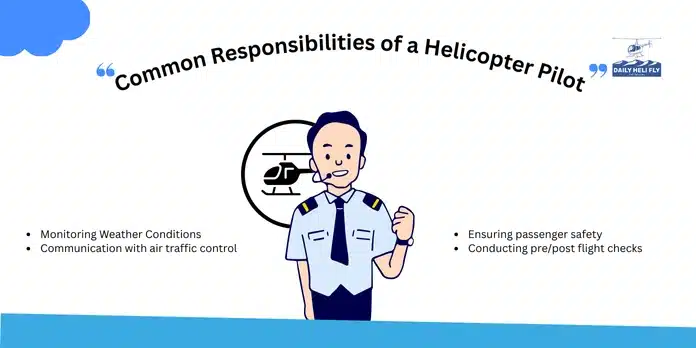
- Safely operating the helicopter during takeoff, flight, and landing: A helicopter pilot should have much attention to the control of the plane at each phase of the flight. This encompasses easy landing, level flight, and safe landing, which is often in tricky areas like mountain helipads or in small open areas.
- Monitoring weather conditions before and during flights: There is a rapid change in weather, particularly in areas such as mountains. Pilots frequently monitor weather reports and ensure that they are on the alert during the flight to maintain safe flying.
- Communicating with air traffic control: Pilots always have direct communication with air traffic controllers to get flight directions, keep the other aircraft informed of their locations, and ensure that they are not in harm’s way of each other.
- Ensuring passenger safety: It is the pilot who takes care of the onboard safety of all passengers. This involves passenger briefing, adherence to the safety measures, and decision-making when on air.
- Conducting pre-flight and post-flight checks: Before and after each flight, a pilot will check the helicopter to check that everything is functioning correctly and the plane is fit to fly.
Types of Helicopter Pilots
Helicopter pilots can work in a wide range of fields, depending on their training and experience:
- Tourism pilots are involved in flying sightseeing and mountain tours whereby their passengers have a scenic aerial view.
- Charter pilots make private clients fly between destinations in a comfortable and fast way.
- The rescue and medical evacuation pilots work during emergencies and contribute to saving lives by carrying with them the injured or sick.
- The military helicopter pilots are the people who use the helicopters to defend, transport and strategically.
- Flight instructors educate and develop new pilots as well as assist them in developing skills and confidence.
- Utility pilots assist in the construction, fire-fighting, and power line work in the most challenging situations.
Although the job descriptions might need extra training or exposure, everyone will follow the same route to become a helicopter pilot.
Basic Eligibility Requirements to Become a Helicopter Pilot
You have to satisfy some minimum eligibility criteria before you start your training process and become a helicopter pilot. These requirements are adhered to all over the world, and they are made in such a way that they would enable the helicopter pilots to know how to fly safely and responsibly. Although it might be a strict process, most of these conditions are met.
Minimum Age Requirement
The issue of age is also a significant consideration when training to be a helicopter pilot.
- Applicants must be aged 18 years to apply for a Private Helicopter Pilot License.
- For a Commercial Helicopter Pilot License, the age requirement is normally 18-21 years old, and this is usually based on the regulations of the aviation authority.
These are the age restrictions that are set so that the pilots are mature enough and can make decisions about flying in helicopters.
Educational Qualification
Education is one of the major concerns of newcomers, and the good news is that one does not need a college degree when pursuing a career as a helicopter pilot. Vitality: A rudimentary level of education in school is normally adequate. Nevertheless, it is significant to have a good knowledge of the English language since communication in the air, manuals, and training are all done in English globally. This assists pilots in effective communication and prevents misunderstanding when flying.
Medical Fitness
The ability to be a helicopter pilot is an important aspect of learning that requires medical fitness. Every prospective pilot has to complete an aviation medical test by a registered doctor.
- The private helicopter pilots will be required to obtain a Class 2 Medical Certificate.
- Helicopter pilots on commercial activities need a Class 1 Medical Certificate.
The medical test verifies the eyesight, hearing, heart, and physical fitness to make sure that pilots can support the physical and mental challenges of flying safely.
Step-by-Step Process to Become a Helicopter Pilot
To be able to know how to become a helicopter pilot, one should understand that there is a definite and systematic process that the journey follows. One step leads to another, and you will slowly fly away with the rudimentary knowledge and transform into a professional with flying skills. We will divide the whole process into steps to ensure that you can clearly understand what happens initially and then proceed to the next stage.
Step 1 – Understand the Different Helicopter Pilot Licenses
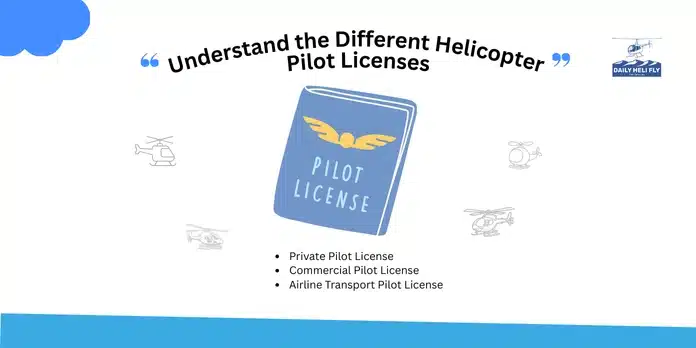
The initial step of the process of learning how to be a helicopter pilot is to know the various types of licenses available. The type of flying is dictated by these licenses.
Private Pilot License (PPL-H)
With a Private Helicopter Pilot License, you can fly helicopters either on a personal or leisure basis. You are allowed to fly either to have fun, train, or commute, and not to get money with this license. It would be best with hobby flyers or those who do not want to make it a profession and would like to experience flying a helicopter.
Commercial Pilot License (CPL-H)
The Commercial Helicopter Pilot License is necessary if you wish to be a professional helicopter pilot. In this license, you can make profits by working with helicopters in the tourism industry, charters, rescue missions, etc. The license is the goal of most people who desire to learn how to become a helicopter pilot as a career.
Airline Transport Pilot License (ATPL-H)
The top rank in licensing of helicopter pilots is ATPL-H. It involves a lot of flying and a high level of knowledge. This is normally the license that is sought later in the career of a pilot who has accumulated a lot of flight hours.
Step 2 – Choose a Certified Helicopter Flight School
One of the most significant processes on the way to becoming a helicopter pilot is choosing the right flight school. A helicopter school of flight also offers theoretical instruction (ground school) and practical flight instruction.
What to Look for in a Flight School
- Approval from aviation authorities
- Experienced and qualified instructors
- Strong safety standards and records
- Clear and structured training programs
- Well-maintained helicopters used for training
You can decide to be trained either at home or in a foreign country, depending on your budget, availability, and other plans you may have in the future for your career. The choice of the appropriate school has a direct influence on your level of training, confidence, and your future success as a helicopter pilot.
Step 3 – Complete Ground School Training
The classroom stage of teaching the helicopter pilots is known as ground school. Although flying can be considered the most adventurous aspect of it, there is ground school that is needed to learn how helicopters fly safely.
Subjects You Will Learn
- Basic aerodynamics, explaining how helicopters generate lift
- Meteorology, which helps pilots understand weather patterns
- Navigation, including map reading and route planning
- Aviation rules and regulations, ensuring legal and safe operations
- Human performance and safety, focusing on decision-making and pilot health
This step makes aspiring pilots learn the fact that helicopters act the way they do in the air since they are the safer and more confident flyers.
Step 4 – Build Required Flight Hours
Learning how to be a helicopter pilot involves much practical flying experience. The art of flying is enhanced by repetition, practice, and experience.
Flight Training Includes
- Dual flights, where you fly with an instructor
- Solo flights, where you fly independently under supervision
- Practicing emergency procedures
- Mastering hovering, takeoff, and landing
- Completing navigation flights
Minimum Flight Hours
- PPL-H: approximately 40–50 flight hours
- CPL-H: approximately 150–200 flight hours
The more time you spend in the air, the more confidence and skill level you have, and the opportunities you have as a helicopter pilot.
Step 5 – Pass Written, Oral, and Flight Exams
To be a helicopter pilot officially, you have to pass several examinations:
- Written exams to test theoretical knowledge
- Oral exams to assess understanding and decision-making
- Skill test or check ride, where an examiner evaluates your flying ability
Such exams will guarantee that you will be able to operate a helicopter safely and responsibly.
Step 6 – Obtain Your Helicopter Pilot License
When you are through with all the examinations, your license to become a helicopter pilot is awarded by the aviation authorities. At this stage:
- You are legally authorized to fly helicopters
- You must maintain medical fitness
- Licenses and medical certificates require periodic renewal
This step officially completes the licensing process of how to become a helicopter pilot.
Step 7 – Gain Experience and Specialize
Once you have your helicopter pilot license, the last thing that you need to learn about how to become a helicopter pilot is the real-life flying experience. At this point, the majority of new pilots start with simple jobs in the field of flying and slowly develop their careers.
Specialization Options
- Mountain flying – conducting helicopters in the mountainous and difficult landscapes.
- Night flying – flying during the night with high levels of navigation.
- Rescue and emergency operations – being engaged in medical evacuation and search-and-rescue operations.
- Tourism flights – flying scenic and sightseeing helicopter tours.
- Instructor ratings – training and mentoring new helicopter pilot students
The only way to achieve job-growth, improved employment, and a greater earning potential in the long term as a helicopter pilot is to gain experience and the choice of specialization.
Career Opportunities After Becoming a Helicopter Pilot
After you are trained and have the full knowledge of how to be a helicopter pilot, you will have a wide variety of career openings. Many industries require helicopter pilots due to the nature of operations that helicopters are capable of undertaking in places that are not easily accessible by other aircraft. The more experience and time of flight put in, the more specialized and higher pay the pilots tend to have.
Popular Career Paths
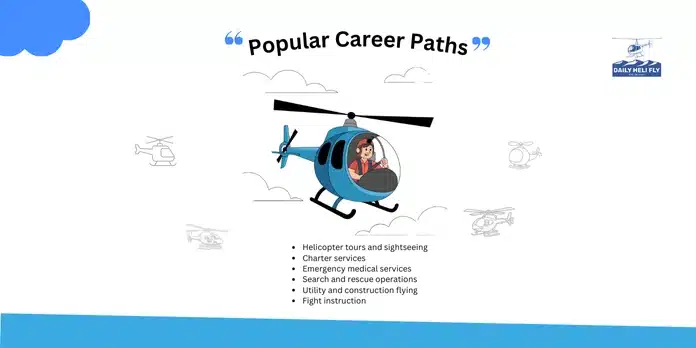
- Helicopter tours and sightseeing: In the tourism industry, a number of helicopter pilots are employed in providing scenic and sightseeing tours around the mountains, cities, and other natural features. It is a popular position in the adventure tourism areas, and pilots can combine the skills of flying with the services of passengers.
- Charter services: Charter helicopters fly private clients, business travelers, and VIPs. These flights are comfort-oriented, efficient in terms of time, and professional, thus have a significant stake in the helicopter industry.
- Emergency medical services: In case of emergencies, helicopter pilots are used to deliver medical services by transporting patients, medical equipment, and the doctor. This job demands a person to make decisions calmly and work under pressure.
- Search and rescue operations: Search and rescue pilots aid in searching and rescuing individuals in remote or dangerous regions. This is among the most challenging but rewarding careers as a helicopter pilot.
- Utility and construction flying: Utility pilots assist in construction projects, power line work, firefighting, and other special-purpose missions that demand accuracy in flying.
- Flight instruction: Experienced pilots may become flight instructors and train a new pupil, and make him learn how to become a helicopter pilot by himself.
As the experience advances, the helicopter pilots could be assigned more advanced positions that are more responsible, have more job security, and higher income prospects.
Skills You Need to Be a Successful Helicopter Pilot
It is not just about training and licensing to know how to be a helicopter pilot. It is also necessary to acquire the appropriate skills and mentality to be a successful helicopter pilot.
Important Skills
- Strong decision-making: The pilots in the helicopters are required to make sound and fast decisions, particularly in inclement weather or in case of emergencies.
- Calm mindset under pressure: It is necessary to remain cool when facing stressful circumstances to ensure safety and control.
- Good communication: A helicopter pilot has the most important duty of ensuring that he or she communicates clearly with the air traffic control, the crew members, and the passengers.
- Physical fitness: Good physical health enables the pilots to cope with long hours, concentration, and the physical rigors of flying.
- Situational awareness: The pilgrims should have a constant look at their environment, aircraft, and weather conditions.
- Discipline and responsibility: Adherence to procedures and a professional attitude are the reasons behind safe and reliable helicopter operations.
These skills develop gradually through training, experience, and continuous learning, making them essential for a long and successful helicopter pilot career.
Conclusion
It might appear difficult to learn how to be a helicopter pilot, particularly when one is a beginner and has no aviation background. But once the process is translated into small and easy steps, then it becomes far easier to comprehend and follow. All these steps are significant in making a successful helicopter pilot because of the minimum eligibility criteria and selection of the appropriate flight school through the training process, issuance of a license, and practical experience.
The life of a helicopter pilot is demanding, long and hard, and on the other hand it is exciting, responsible, and offers long term career. In case flying the helicopters is indeed your passion, and you have the time and the effort to devote to this cause, this can be a life-changing and rewarding experience.
FAQs:
How long does it take to become a helicopter pilot?
Learning to be a helicopter pilot is a time-consuming undertaking, which relies on how much you train, when you train, and whether or not you train full-time or part-time. It may require approximately 6 to 12 months to complete an average earning of a Private Helicopter Pilot License, without mentioning that it may require 12 to 24 months before one becomes a commercial helicopter pilot. The schedule can also be influenced by the weather conditions, flight school timing, and individual determination.
How to become a helicopter pilot in Nepal?
To know how to become a helicopter pilot in Nepal, you have to fulfill the minimum eligibility requirements, such as age, education, and fitness. The training should be done in a flight school approved by the aviation authority, and thereafter, the ground exams, flight test, and medical checks are to be passed by the aviation authorities in Nepal. Nepal has many pilots, whose initial training is private, and they later train to become commercial helicopter pilots.
What qualifications do you need to fly a helicopter?
To fly a helicopter, you do not have to be college-educated. The necessary qualifications are a basic school education, good command of English, and an aviation medical exam. In addition, to fly legally, you have to undergo flight training and acquire the necessary helicopter pilot license, depending on whether you wish to fly privately or professionally.
Is it difficult to become a helicopter pilot?
It may not be easy to learn anything on how to become a helicopter pilot, but that is not impossible. The training must be disciplined, focused, and regular. Even with no previous aviation experience, with the right attitude, a good flight school, and suitable guidance, a great number of beginners manage to graduate as helicopter pilots.


